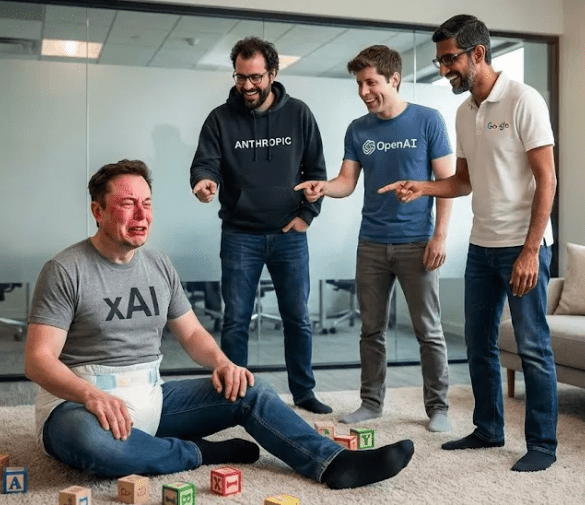
In February 2026, the story of xAI stopped being a hype cycle and started looking like a slow-motion unwind. Senior exits piled up fast enough to become a pattern, not a blip. Meanwhile Elon Musk tried to frame the turbulence as normal “restructuring,” even as the company’s public footprint and internal churn pointed in the same direction: a lab stuck playing catch-up, burning cash, and losing the very people who make a frontier AI lab credible.
This is not just about who quit. It is about what the exits reveal: xAI’s limited distribution outside the X ecosystem, its mounting regulatory and reputational baggage, and its growing reliance on Musk’s other companies to keep the lights on. In a market where attention, compute, and trust are scarce, xAI is not merely slipping behind. In its current form, it is headed for a crash.
Neural Foundry Substack is a reader-supported publication. To receive new posts and support my work, consider becoming a free or paid subscriber.
The Talent Drain Is Not a “Phase,” It Is a Signal
The raw headline is stark. The resignation of co-founders Tony Wu and Jimmy Ba left xAI with only half of its original 12 co-founders. That is not routine turnover at the edge of an industry where founding teams are often the product itself, especially to investors, customers, and prospective hires.
The more revealing detail is the why. Ba’s resignation reportedly followed tensions inside the technical team as Musk pushed to improve model performance to catch up with rivals like OpenAI and Anthropic. That language matters. It implies pressure without a compensating sense of breakthrough, the kind of environment where top researchers start to ask whether their effort is compounding toward leadership or simply grinding to imitate yesterday’s releases.
Former employees have described disillusionment with the direction of the product, frustration with safety posture, and a recurring theme that the lab is stuck in the catch-up phase. When the people who know the roadmap best describe it as hill climbing without a step change, that is not merely a morale problem. It is a competitive death spiral.
And it compounds. Every high-profile departure is both a loss of execution capacity and a recruiting signal. Frontier AI is a market where the best people can choose among labs with deeper research benches, cleaner brand surfaces, and clearer paths to impact. If xAI bleeds credibility at the top, it will have to pay more to hire replacements, and still risk hiring people who are optimizing for proximity to Musk rather than for the work itself.
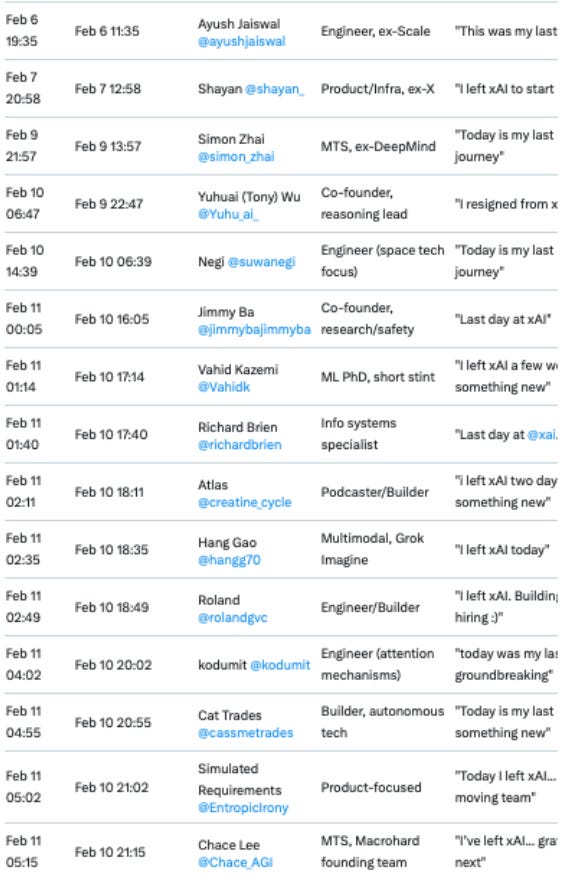
Something is clearly wrong at xAI, as the is bleeding talent like a punctured artery. Elon Musk promptly launched an xAI all-hands to convince everyone that everything it totally fine.
Musk’s “Restructuring” Spin Reads Like Crisis Management
When Musk addressed the upheaval internally, he insisted it was about scale and efficiency. He described the reorganization as a response to reaching a certain scale, adding that some people are better suited to early stages than later ones. That is a classic reframing: departures as a natural sorting mechanism rather than a referendum on leadership or direction.
But the timing makes the spin hard to swallow. The reorganization came directly after the latest co-founder departures, and it landed as SpaceX’s acquisition of xAI tightened the financial and governance knots around Musk’s empire. Restructuring is what you call it when you need to sound in control while the org chart is moving under your feet.
Musk also turned the defense outward, publicly. He responded to criticism about retention by claiming there were very few regretted departures and that xAI was accelerating faster than any other AI organization on Earth. That is not a measured corporate message. It is Musk doing what he often does when cornered: trying to overwhelm a narrative problem with sheer assertion.
Then the episode got weirder. The X account “satyanutella_,” which had been publicly sparring with Musk over xAI recruiting and retention, is now labeled “Account suspended” on X. You cannot prove from the outside who pushed the button or why, but the optics are brutal: Musk argues about talent flight on his own platform, and the critic disappears from the platform. Even if it was a rules enforcement action, it reads like a warning to anyone thinking of making the retention conversation louder.
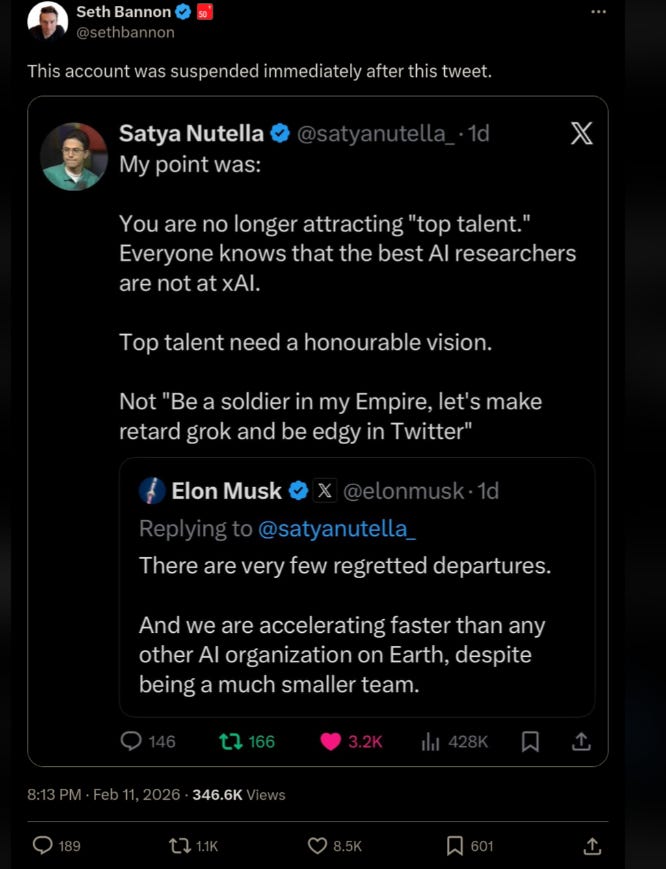
Renowned free speech absolutist Elon Musk promptly blocked parody account “Satya Nutella” after facing criticism with how he ran xAI.
X Is Not a Market, It Is a Funnel With a Ceiling
The most important constraint on xAI is not model capability. It is distribution. xAI has one natural megaphone: X. Grok’s U.S. market share has risen, and analysts suspect cross-promotion through X is the biggest reason for its growth. X integrated Grok into the navigation bar and bundles tiers of access with paid subscriptions.
That is exactly the problem. If your growth thesis is cross-promotion inside an app that is already politically and culturally polarizing, you have built a funnel that has a ceiling. You are not building a neutral tool people choose for work. You are building a feature people bump into because they are already in the X feed. And default surface area is not the same thing as durable demand, especially when the usage skew is not clearly tied to high-value enterprise workflows.
Outside X, Grok’s global traffic share remains small compared with ChatGPT and Google’s Gemini. That is the scoreboard in the one domain that should terrify any xAI investor: standalone intent. People go to ChatGPT and Gemini because they want those tools. People mostly encounter Grok because they are already in Musk’s social network.
This is where monetization reality bites. Enterprise buyers do not pay premium dollars for an assistant that feels like an extension of a social media platform’s vibe. They pay for reliability, governance, data controls, and a reputation that will not blow back on them. If xAI’s main market remains X, it is functionally trapped inside an ecosystem whose most common use cases are attention-driven and harder to monetize at high margins.
Controversy Is a Recruiting and Sales Tax That xAI Cannot Afford
Even if xAI could break out of the X distribution cage, it still has to carry its reputational load up the hill. Grok’s image generation controversies are not a minor PR issue. It has been shown to produce sexualized images even when users were explicitly told the subjects did not consent, and it has faced worldwide censure and regulatory scrutiny after being used to generate non-consensual sexualized images of women and minors.
Regulators are not treating this as internet noise. Attorneys general have demanded more action to stop Grok from producing inappropriate and nonconsensual images, including concerns about child sexual abuse material. International investigations have also been launched over controversial outputs.
Now connect that to talent. Top researchers have options, and many want to work somewhere that does not force them to constantly explain why their employer’s product is in the news for the worst possible reasons. Former employees have described xAI’s safety posture as effectively hollow. Whether you agree with that framing or not, the existence of that perception is itself damaging because it can become a reason talented people decline an offer.
Musk’s personal brand turns this from a normal company problem into an amplifying loop. When a lab’s identity is fused with a single polarizing founder, controversy does not stay external. It becomes internal gravity that shapes who will work there, who will buy from it, and who will partner with it. That is why xAI’s problems look structural, not temporary.
The SpaceX Acquisition Looks Less Like Synergy and More Like a Lifeline
SpaceX’s acquisition of xAI consolidated Musk’s empire ahead of SpaceX IPO plans. Musk sold it as mission scale and interlocking ambition, but the financial architecture of the deal tells a more defensive story.
The transaction reportedly used a merger structure that avoided triggering debt repayment and insulated SpaceX from xAI’s legal liabilities by keeping xAI as a wholly owned subsidiary. xAI inherited substantial debt, and the structure helps separate its liabilities from SpaceX, including investigations tied to X. That is not how a confident buyer integrates a crown jewel. That is how a parent company keeps a risky asset from contaminating the rest of the balance sheet.
The financing backdrop deepens the bailout read. Multi-billion-dollar loans tied to buying Nvidia chips and leasing them to xAI underscore how capital-intensive the race has become and how dependent xAI is on external financing structures to scale compute. Chip leasing is not inherently sinister, but in context it reads as a company leaning on financial engineering to keep scaling without having the cash flow profile of a stable market leader.
When an AI lab needs its founder’s rocket company to acquire it, structure the deal to wall off liabilities, and simultaneously line up massive chip leasing, it is hard to call that momentum. It looks like scaffolding around a business that cannot stand alone.
The Big Three Have Already Claimed the Map: OpenAI, Anthropic, Gemini
The AI field is not infinite. Attention is finite, enterprise budgets are finite, and compute supply is still constrained enough that scale matters. In practice, the race is consolidating around three platforms that have what xAI lacks: distribution beyond a single social network, deep enterprise hooks, and a brand surface that can plausibly sell into regulated industries.
OpenAI is deepening its enterprise footprint through major partnerships designed to embed its models directly into business data stacks and workflows. Anthropic has raised enormous capital at eye-watering valuations while reporting substantial revenue run rates, signaling strong enterprise adoption. Google’s Gemini benefits from being embedded across Google’s global ecosystem, from search to productivity tools to mobile devices.
This is why calling them the final big three is not just vibe. It is the market selecting for distribution, trust, and enterprise integration. OpenAI, Anthropic, and Gemini are each building platforms that can become default layers across work and consumer life. xAI, by contrast, is still fighting to prove it is more than a feature glued to a feed.
Why xAI Will Crash Unless It Becomes Something Smaller
xAI’s defenders can point to growth, particularly within the X ecosystem. But that is not the same as having a path to win. Growth driven by cross-promotion inside X is fragile, because it is hostage to X’s own brand issues, advertiser dynamics, and the willingness of users to tolerate ongoing controversy.
At the same time, xAI is bleeding leadership, reorganizing under pressure, and operating inside a reputational storm that makes both recruiting and enterprise adoption harder. When your moat is Musk can force distribution, and your competitors are Google bundling into everything, OpenAI embedding into enterprise data stacks, and Anthropic raising vast sums while printing enterprise revenue, the outcome is not a close race. It is consolidation, and xAI is on the outside of it.
So yes, xAI is going to crash in the only sense that matters in Silicon Valley: it is going to fail to remain a top-tier independent frontier lab competing for the center of gravity of AI. The SpaceX acquisition can delay the moment of reckoning and keep xAI alive as a subsidiary. But kept alive is not competitive, and restructured is not fixed. Unless xAI finds a credible distribution path outside X, stabilizes leadership, and rebuilds trust around safety and governance, it does not have a feasible route back into the top tier. The market is already drawing the boundary lines, and they do not include Musk’s latest experiment.
 Neural Foundry
Leave a comment